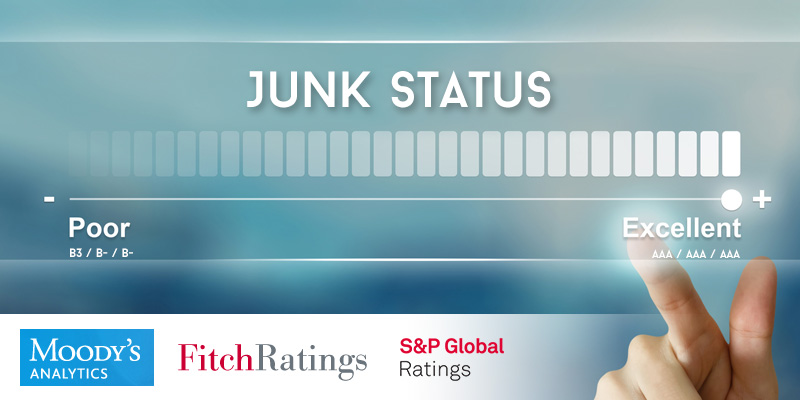
A lot of us have heard of South Africa’s investment status being downgraded to ‘junk status’. Some of our readers have been asking us what this means. Have you ever wondered what this means and how it affects us?
Who Rates A Country?
The world’s Big Three credit rating agencies, namely Standard & Poor’s, Moody’s and Fitch Ratings. They rate national economies according to their credit worthiness. This is based on the likelihood of the government being able to repay its foreign debt and risk level for foreign investors.
What is Junk Status?
The ratings agencies basically give countries marks out of 100 but use letters instead. Ratings range from the virtually riskless ‘prime rating’ (AAA) via small gradients (AA+, AA, AA-, A+, A, A-, BBB+, BBB, BBB-, BB+, BB etc) all the way down to rock bottom ‘in default’ (D).
Anything below BBB- (or 55 out of 100) is essentially a ‘fail’ or in business -speak, ‘non-investment grade’ or ‘junk status’.
Who else is in the junk status club?
Countries such as the Bahamas and Russia have also been part of this club. The list also includes Azerbaijan, Bulgaria, Indonesia, Turkey and Portugal.
Numerous countries are worse off or “consigned to the dustbin” as the World Economic Forum once called it. On this list you will find countries such as Mozambique, Puerto Rico and Venezuela.
Top of the class for investors (with unanimous AAA grades) are, among others, Australia, Canada, the Netherlands, Germany, Singapore, Sweden and Switzerland.
Should We Care If We Have A Junk Status Rating?
Definitely. The rating means the global financial community has lost its confidence in the South African economy. In other words, the finance world believes that our government is unlikely to repay its foreign debt.
This is not good, because it tells foreign investors we are a risk. The result will be less foreign direct investment which means less money flows into the country and fewer jobs are created.
Junk status rating also makes it more difficult for our government to borrow on the international markets. When we do get it, we will have to pay more in interest. This means less money for public spending on things like social grants and investment in roads, clinics and schools.
Is There Any Good News?
Well, getting a bad rating is not the end of the world. Countries such as Croatia, Ireland, Latvia and Slovenia have bounced back from junk status. As long as the government gets a wake up call and fixes what is wrong with the economy SA can also bounce back.
What is the latest rating and previous ratings?
As of April 2020, Standard & Poor’s credit rating for South Africa stands at BB- with stable outlook. Moody’s credit rating for South Africa was last set at Ba1 with negative outlook. Fitch’s credit rating for South Africa was last reported at BB with negative outlook.
| Agency | Rating | Outlook | Date |
| S&P | BB- | stable | Apr 30 2020 |
| Fitch | BB | negative | Apr 03 2020 |
| Moody’s | Ba1 | negative | Mar 27 2020 |
| S&P | BB | negative | Nov 22 2019 |
| Moody’s | Baa3 | negative | Nov 01 2019 |
| Fitch | BB+ | negative | Jul 26 2019 |
| Moody’s | Baa3 | stable | Mar 23 2018 |
| S&P | BB | stable | Nov 24 2017 |
| Moody’s | Baa3 | under review | Nov 24 2017 |
| Moody’s | Baa3 | negative | Jun 09 2017 |
| Fitch | BB+ | stable | Apr 07 2017 |
| Moody’s | Baa2 | negative watch | Apr 03 2017 |
| S&P | BB+ | negative | Apr 03 2017 |
| Fitch | BBB- | negative | Nov 25 2016 |
| Moody’s | Baa2 | negative | May 06 2016 |
| Moody’s | Baa2 | negative watch | Mar 08 2016 |
| S&P | BBB- | negative | Dec 04 2015 |
| Fitch | BBB- | stable | Dec 04 2015 |
| Moody’s | Baa2 | negative | Nov 06 2014 |
| Moody’s | Baa2 | stable | Nov 06 2014 |
| Fitch | BBB | negative | Jun 13 2014 |
| S&P | BBB- | stable | Jun 13 2014 |
| Fitch | BBB | stable | Jan 10 2013 |
| S&P | BBB | negative | Oct 12 2012 |
| Moody’s | Baa1 | negative | Sep 27 2012 |
| S&P | BBB+ | negative | Mar 28 2012 |
| Fitch | BBB+ | negative | Jan 13 2012 |
| Moody’s | A3 | negative | Nov 09 2011 |
| S&P | BBB+ | stable | Jan 25 2011 |
| Fitch | BBB+ | stable | Jan 17 2011 |
| Moody’s | A3 | stable | Jul 16 2009 |
| S&P | BBB+ | negative | Nov 11 2008 |
| Fitch | BBB+ | negative | Nov 09 2008 |
| Fitch | BBB+ | stable | Jun 17 2008 |
| Fitch | BBB+ | positive | Jul 25 2007 |
| Moody’s | Baa1 | positive | Jun 05 2007 |
| Fitch | BBB+ | stable | Aug 25 2005 |
| S&P | BBB+ | stable | Aug 01 2005 |
| Moody’s | Baa1 | stable | Jan 11 2005 |
| Fitch | BBB | positive | Oct 21 2004 |
| Moody’s | Baa2 | positive watch | Oct 14 2004 |
| S&P | BBB | stable | May 07 2003 |
| Fitch | BBB | stable | May 02 2003 |
| Fitch | BBB- | positive watch | Mar 11 2003 |
| Moody’s | Baa2 | positive | Feb 26 2003 |
| S&P | BBB- | positive | Nov 12 2002 |
| Fitch | BBB- | positive | Aug 20 2002 |
| Moody’s | Baa2 | stable | Nov 29 2001 |
| Moody’s | Baa3 | positive watch | Oct 12 2001 |
| Fitch | BBB- | stable | Sep 21 2000 |
| Fitch | BBB- | n/a | Jun 27 2000 |
| Fitch | BB+ | n/a | May 19 2000 |
| S&P | BBB- | stable | Feb 25 2000 |
| Moody’s | Baa3 | positive | Feb 07 2000 |
| Moody’s | Baa3 | stable | Oct 08 1998 |
| Moody’s | Baa3 | negative watch | Jul 17 1998 |
| Fitch | BB | n/a | May 28 1998 |
| Fitch | BB | positive watch | Feb 17 1998 |
| S&P | BB+ | stable | Nov 20 1995 |
| S&P | BB | stable | Oct 03 1994 |
| Moody’s | Baa3 | stable | Oct 03 1994 |
| Fitch | BB | n/a | Sep 22 1994 |